Voices I’ve Loved and Adapted
Source Materials’ Hold on My Playwriting
A great deal of my playwriting has revolved around adaptation – if not direct adaptation, at least inspiration from artists or books: voices that inspire me. I think that’s the core instinct – voices I feel have a place on the stage and ones I’d love to share with audiences who might not know them.
From the very beginning it’s been like that. My first adaptation was a commission by Jane Mandel (by her Next Generation Theatre), adapting The Girl of the Limberlost, written in 1910 (interestingly, a contender with Gone With the Wind for the most books sold that year). I had not myself read it as a child, but when I did, I recognized my mother’s voice in it – the voice and world of a high-spirited, intelligent girl who desperately needed and wanted to expand beyond her limited environment. So it was an unexpected honor to bring the voice of Elnora Comstock to the stage. (Thank you, Jane.) It was my first full-blown and my first published play. (I still have work I might like to do on it… perhaps a musical or a contemporary adaptation of the story.)
Next, I was inspired to write a play about anticipated loss – for me, that loss was not a mortal one, but knowing that my first-born daughter was soon going off to college. COUNTING DAYS was set in motion by discovering an old copy of The Letters and Journals of Katherine Mansfield in my bookcase. I don’t know where it came from. But I learned that Mansfield was a brilliant, undervalued writer from the early 1900s. Born in New Zealand, her brief adulthood was spent in London with all the luminaries of the era – and in Paris and Southern France. Afflicted with TB, she guessed her time on earth was limited. She lived, therefore, with a heightened consciousness of beauty around her, and her voice is vital and insistently alive. For me, she inspired hope for a future with focus, awareness and wonder in the world around me. Her journal entries inspired me with a way to ground myself and move into the future with one less chick in the nest. I incorporated many of Mansfield’s thoughts into COUNTING DAYS – and actually created her as a character on stage (along with another character bearing a striking similarity to me). Audiences seemed to really respond and I was hugely glad of that.
I kept an internal running list of voices I had imagined as being theatrical – well-suited for the stage. Voices that were insistent, idiosyncratic, charming – the next would be Moll Flanders, from the first-person (though fictionalized) famous novel I’d studied in college. Written by 18th century novelist Daniel Defoe, the book became the inspiration for my MIDNIGHT AND MOLL FLANDERS, which has done well. Moll’s unstoppable voice was one I aspired to incorporate more of into my own life in my late forties – and one I thought contemporary America needed to hear. I hoped that women (and men) would recognize the strong survivor that Moll was and her parallel in voiceless, economically suppressed women fighting their way in American society.
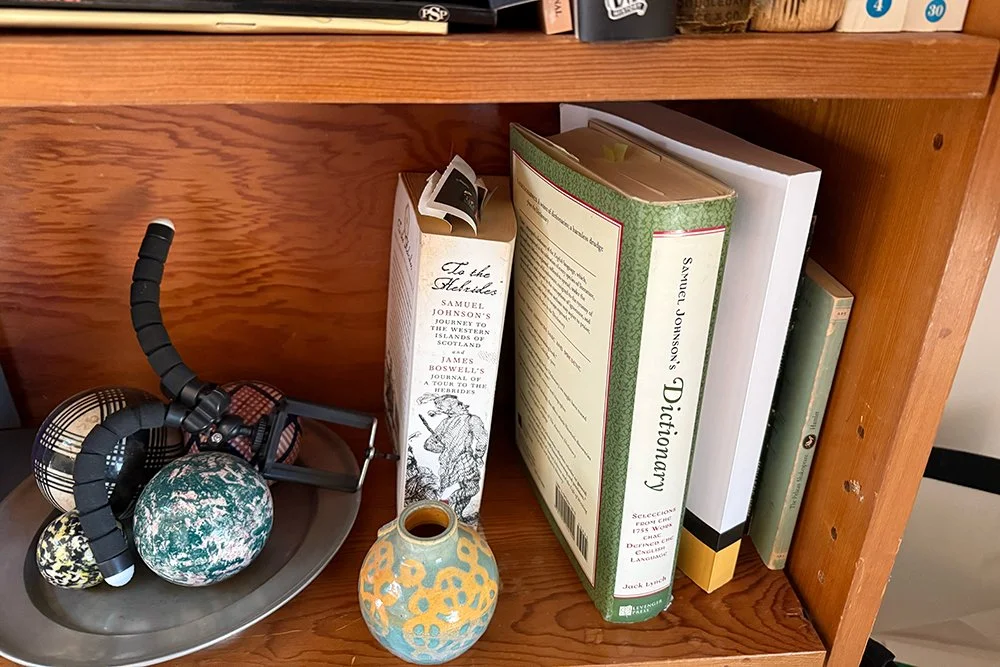
The next voice to persuade me, perhaps surprisingly, was that of James Boswell. I’d experienced his voice as a curious, lonely tween exploring my parents’ library books. When I read it, I was both shocked and delighted by its bawdiness and honesty… so as my playwriting career developed, it kept pushing itself into my playwriting brain like an insistent bur. BOSWELL carried me a long way, dramatically – from Milwaukee (and Renaissance Theaterworks) to Scotland’s Fringe Festival to New York’s Off-Broadway and back to Milwaukee with Next Act Theatre. His flawed but oh-so human voice has, I hope, surprised (and perhaps charmed) audiences as much as it did me.
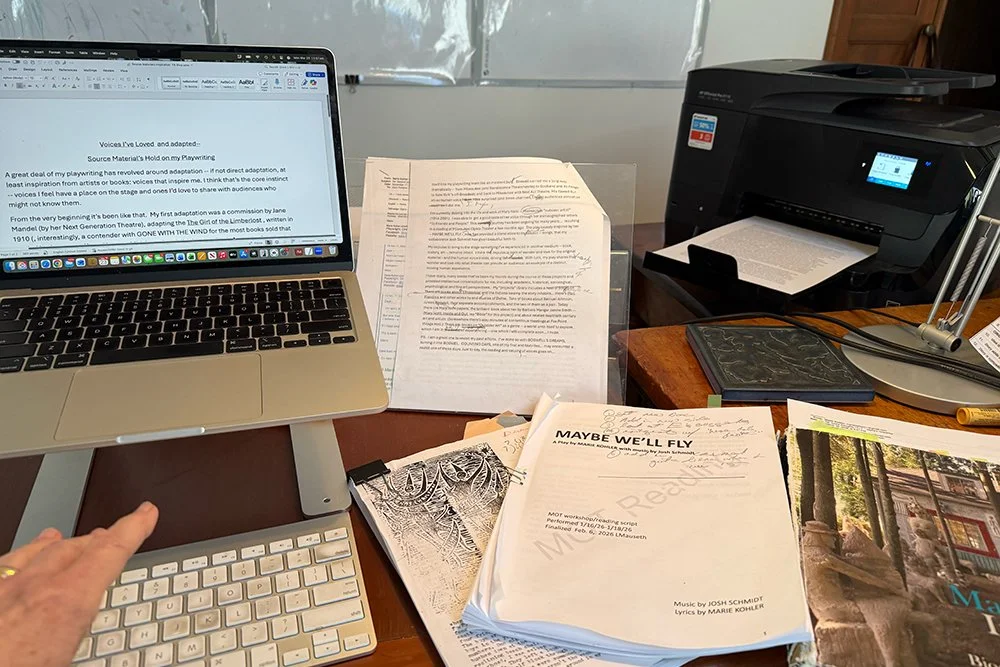
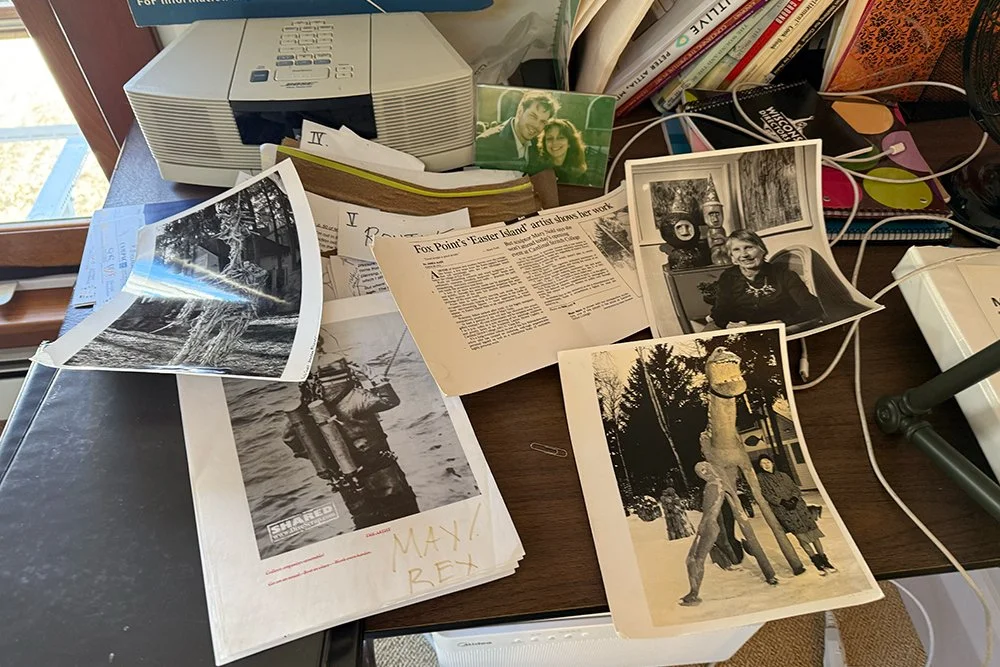
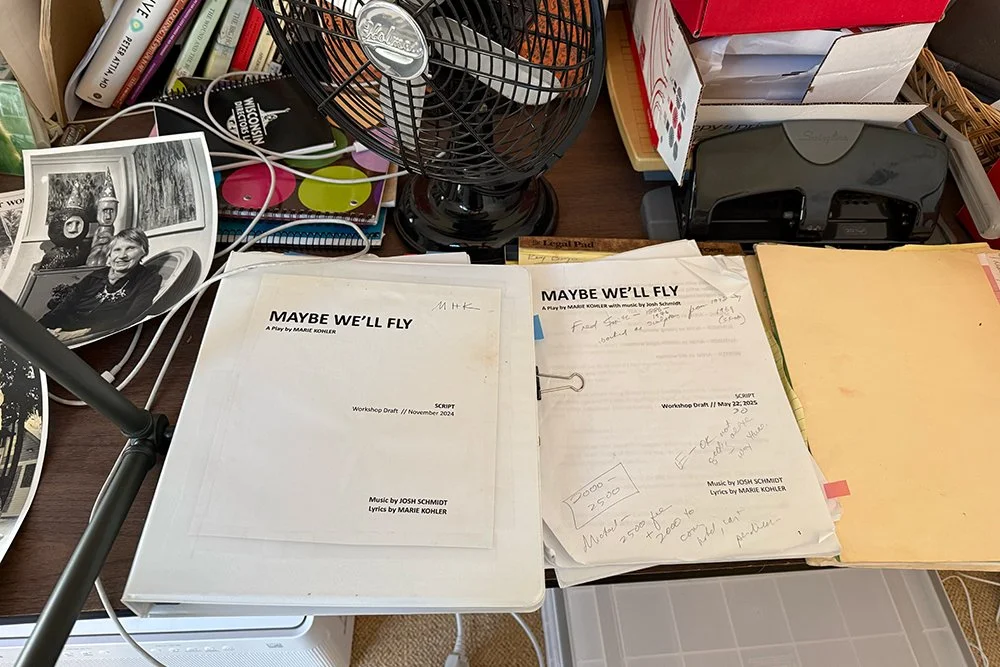
I’m currently delving into the life and work of Mary Nohl – Milwaukee “outsider artist” (1914-2001). I was able to get a good taste of her voice through her mimeographed letters “To Friends and People.” This journey has been ongoing for many years… resulting in a reading at Milwaukee Opera Theater a few months ago. The play loosely inspired by her – MAYBE WE’LL FLY – has provided a literal voice to its protagonist – songs that my collaborator Josh Schmidt has given beautiful form to.
My impulse to bring to the stage something I’ve experienced in another medium – book, history, art – remains intact. I think that impulse is born of wonder and love for the original material – and the human voice inside, driving it. With luck, my play shares that wonder and love into what theater can provide an audience: an example of a distinct, moving human experience.
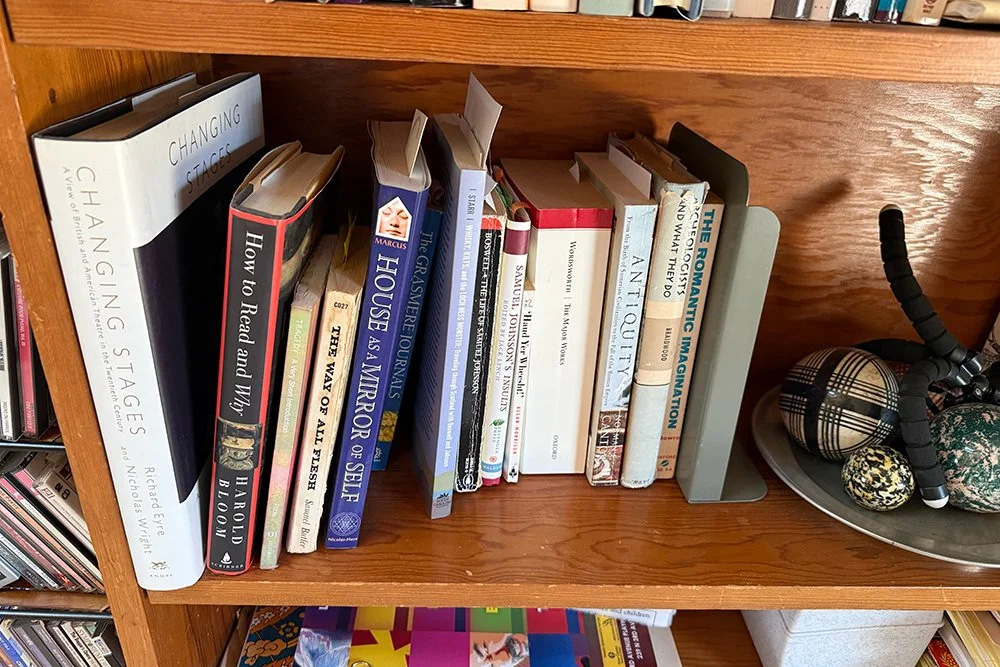
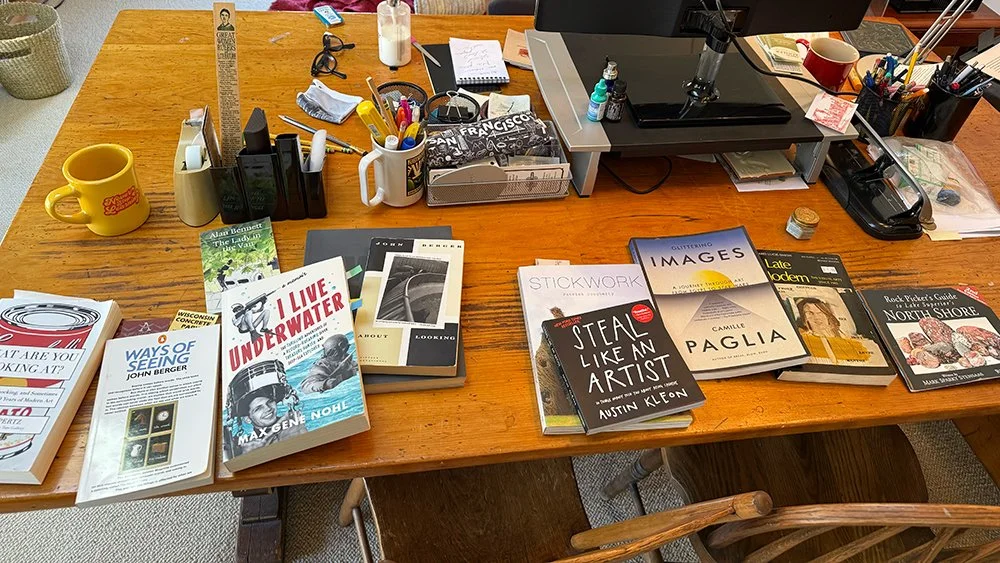
I have many, many books that’ve been my friends during the course of these projects and provided intellectual conversations for me, including academic, historical, sociological, psychological and fine art perspectives. My “Projects Library” includes a host of books about The Limberlost swamp Elnora’s story inhabits… there’s Moll Flanders and other works by and studies of Defoe. Tons of books about Samuel Johnson, James Boswell, their separate accomplishments, and the two of them as a pair. Today there are Mary Nohl papers, the brilliant book about her by Barbara Manger Janine Smith – (Mary Nohl, Inside and Out, my “Bible” for this project) and about related twentieth century art and artists. (Somewhere there’s also minutes of contentious meetings at Fox Point Village Hall.) There are books on “Outsider Art” as a genre – a world unto itself to explore, which I am still experiencing – one which I will complete soon… I hope.
P.S. I am a great one to revisit my past efforts. I’ve done so with BOSWELL’S DREAMS, turning it into BOSWELL. COUNTING DAYS, one of my first and favorites… may encounter a revisit one of these days. Just to say, the reading and valuing of voices goes on…